What is a "tesseract"?
The Geometry of a 4D Cube Explained Simply
If you've ever seen Interstellar or the first few Marvel movies, the term "tesseract" probably sounds familiar. On screen, it’s depicted as a mystical, energy-glowing artifact or a room spanning across time. In reality, however, a tesseract is a very real, precise mathematical concept: the four-dimensional cube (or "hypercube").
But how do we imagine something that our eyes, accustomed to our three-dimensional world, cannot directly perceive? Let's look at the geometry of a hypercube in the simplest possible way!
Dimensional analogy... or from a point to the hypercube
To understand the structure of a four-dimensional cube, it's worth starting from the bottom. For every "dimensional jump" we follow the same simple rule: take the basic shape and pull it into a new direction, perpendicular to the previous one.
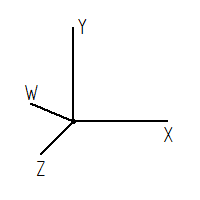 |  |  |
The 4-dimensional coordinate system (each axis is perpendicular to the other three axes) | 0 dimension (point) A single point with no extension. | 1 dimension (segment) Move the black starting point on the left along the X-axis to the red ending point on the right, and you get a segment. The segment has one measure, its only length (2 vertices, 1 edge). |
Continuing the same analogy, we can easily get to the 4-dimensional hypercube...
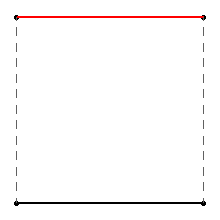 | 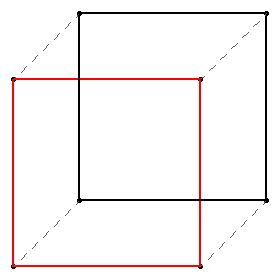 | 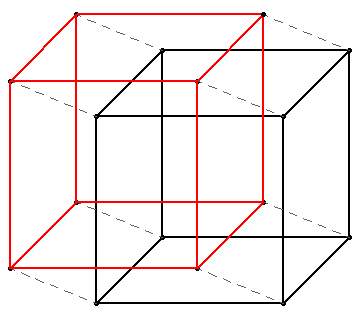 |
2 dimension (square) Move the bottom black segment along the perpendicular Y-axis to the top red segment, and you get a square. The square has two measures, its length and its width, or area (4 vertices, 4 edges). | 3 dimension (cube) Move the back black square along the perpendicular Z-axis to the front red square, and you get a regular cube. The cube now has not only length and width, but also height, which is called a volume (8 vertices, 12 edges, 6 sides). | 4 dimension (hypercube) Move the right black cube along the perpendicular W-axis to the left red cube, and you get a 4D hypercube. This 4D hypercube (or tesseract) now has length, width, and height, as well as a 4D depth, which together are called a "hypervolume". |
Since there is no fourth spatial direction in the world we perceive, we cannot of course perform this fourth "extension" in our physical space – but in the language of mathematics, a tesseract or hypercube is exactly this shape. A tesseract therefore has 16 vertices, 32 edges, 24 sides and 8 three-dimensional bounding cubes, or "cells".
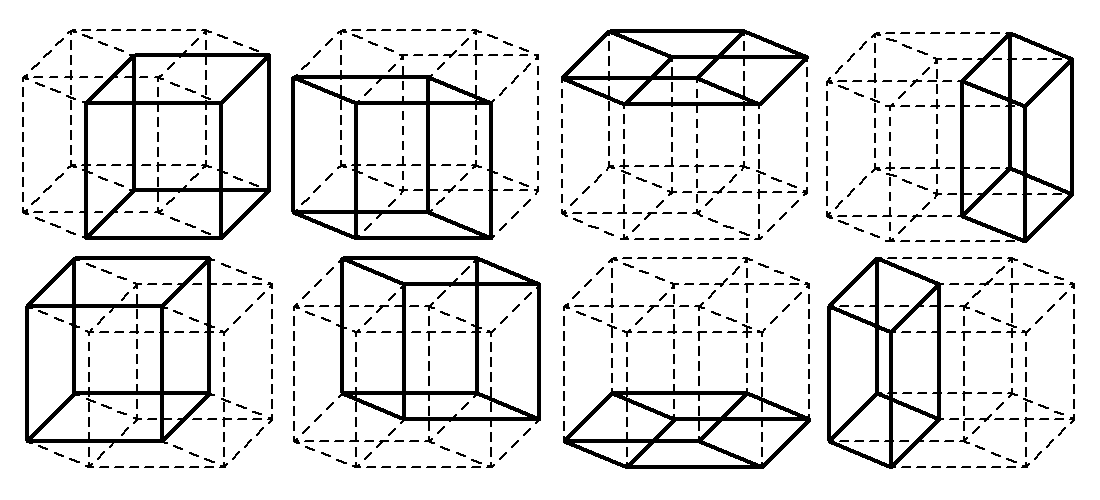
How can we see 4D in our 3D world?
Since we are unfortunately unable to "look out" from our 3D world, 4D objects are usually examined using shadows and projections.
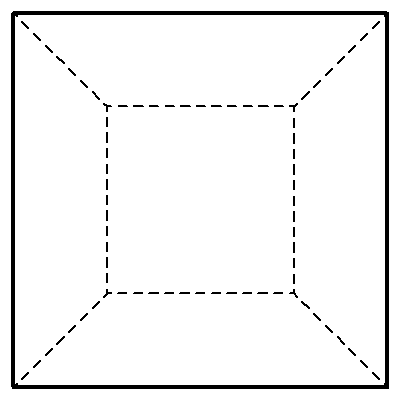 | 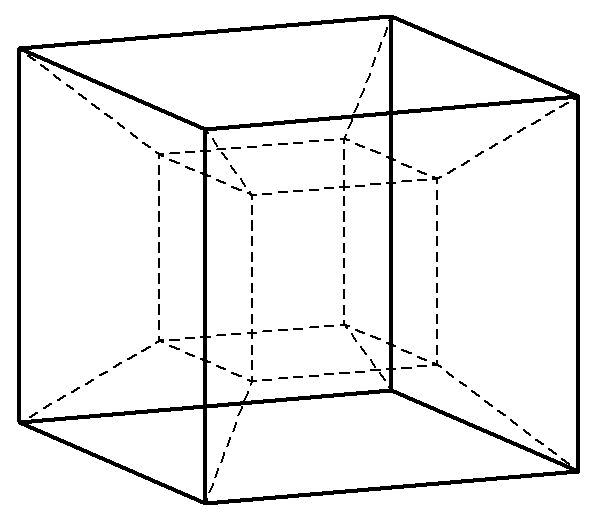 |
Think of a 3D "wire-frame" cube If you shine a light on it, its shadow on the wall will be a 2D shape that will look like a "square within a square". (The dashed line indicates that the back, smaller square is further away from us in 3D space.) | Similarly: When we display a hypercube on the screen, we are actually seeing the 3D shadow of the 4D object, which looks like a "cube within a cube". (The dashed line indicates that the inner, smaller cube is further away from us in 4D hyperspace.) |
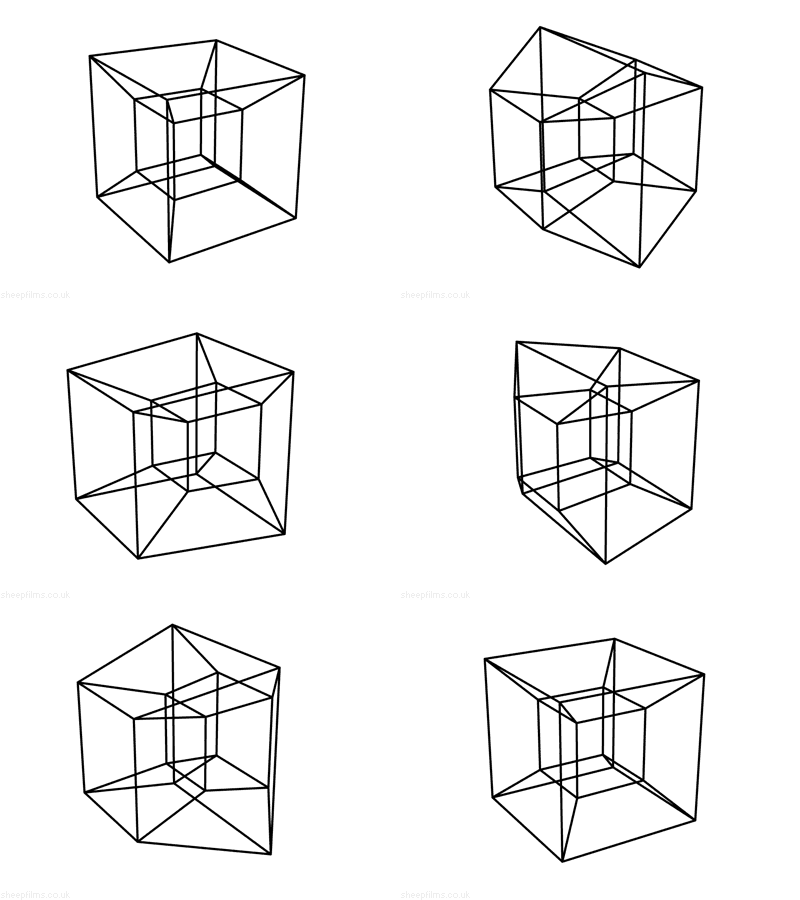 |
4D rotating hypercube... It seems as if the cells of the hypercube are distorted during rotation and the inner cube is "turning out of itself", while the hypercube is only rotating in the fourth dimension and we only perceive the change of its three-dimensional shadow. |
If you want to learn more about the hypercube and the representation of 4-dimensional shapes in 3D, visit this page: https://web.archive.org/web/20220523115703/http://eusebeia.dyndns.org/4d/vis/vis.html
The Hypercube and "tangible" logic puzzles
In the world of logic puzzles, the 4-dimensional Magic Cube is no longer just a theory, but the most serious challenge a cuber can ever encounter.
While on a traditional, 3D Rubik's Cube you can only rotate its 2D sides forward or backward, on a 4D Magic Cube you can rotate its 3D sides forward or backward in the X, Y and Z directions, and in the process the 3-dimensional "cells" of the hypercube exchange places with each other. Understanding the geometry of the hypercube is the first step to not only rotating the cube, but also truly "seeing" the fourth dimension.
Are you curious about what it feels like to hold the fourth dimension in your hands?
Take a look around in our webshop, and try out our 4-dimensional Magic Cubes!
Hashtags: #4D #4Dimension #4Dimensions #Cube #Cubes #CustomCubes #Dimension #Dimensions #Game #Games #Gaming #HyperCube #HyperCubes #HyperCubing #MagicCube #MagicCubes #Puzzle #Puzzles #Rubik #Rubiks #RubikCube #RubikCubes #RubiksCube #RubiksCubes #Tesseract #Toy #Toys #XYZW